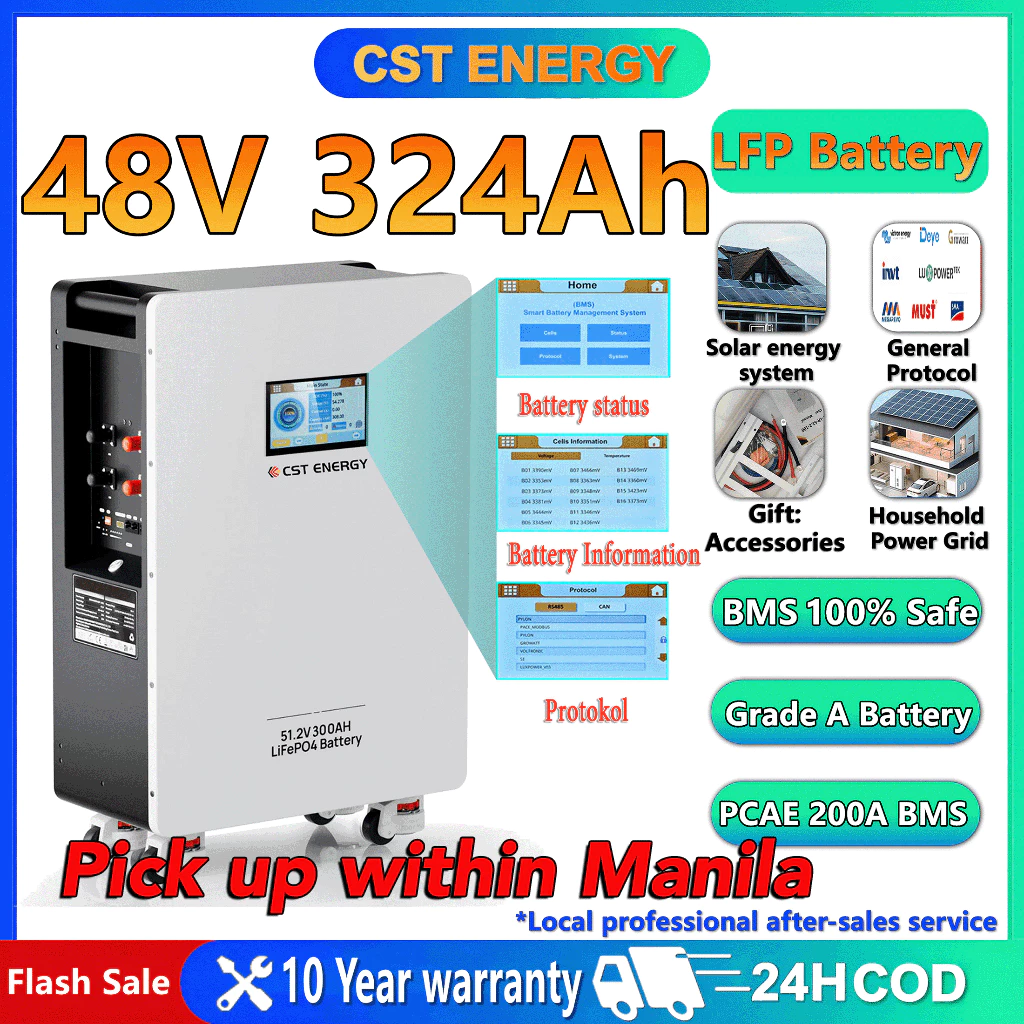
Reliable Battery Storage Is the Heart of a Solar Power System
Solar panels produce electricity during daylight hours, but a battery allows that energy to be stored for use at night, during cloudy weather, or whenever grid power is unavailable.
For home solar kits, farms, outdoor installations, communication equipment, security systems, and remote facilities, choosing the correct battery is just as important as choosing the solar panels and inverter.
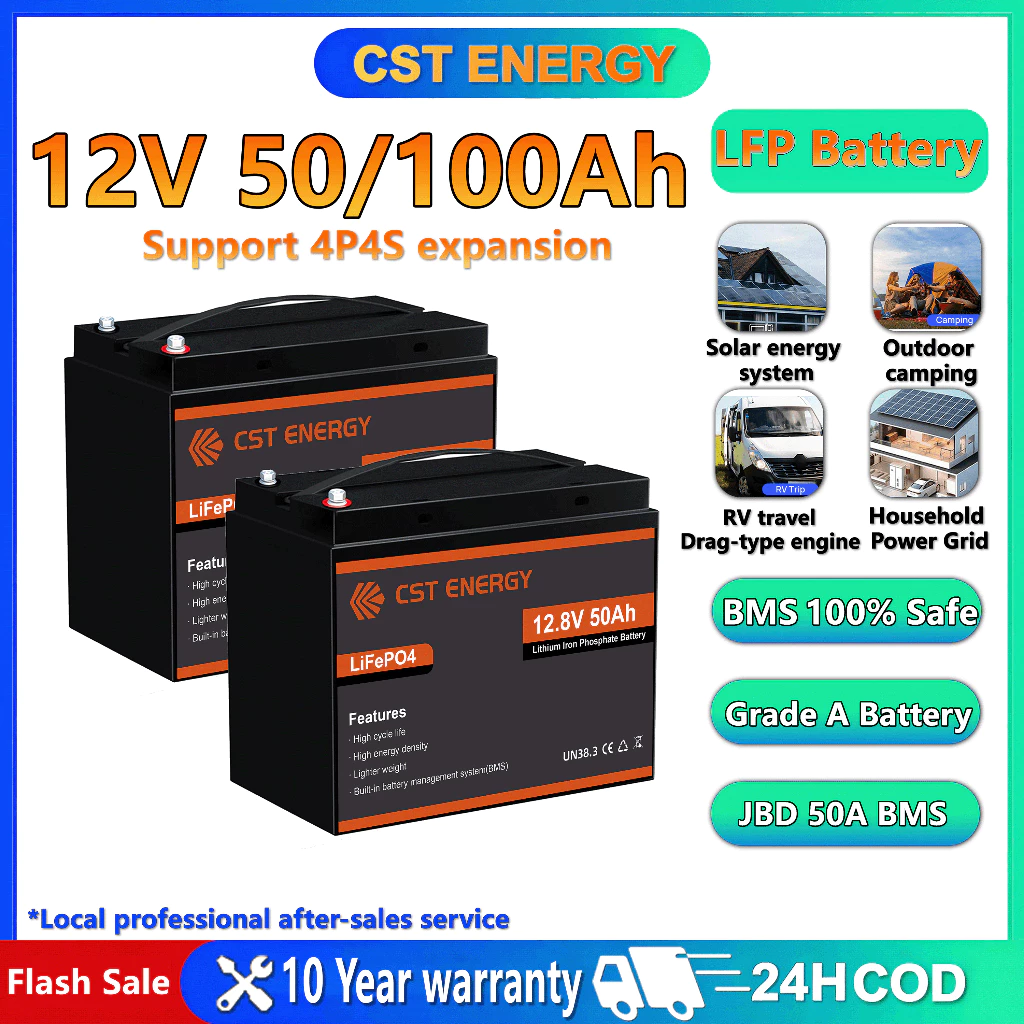
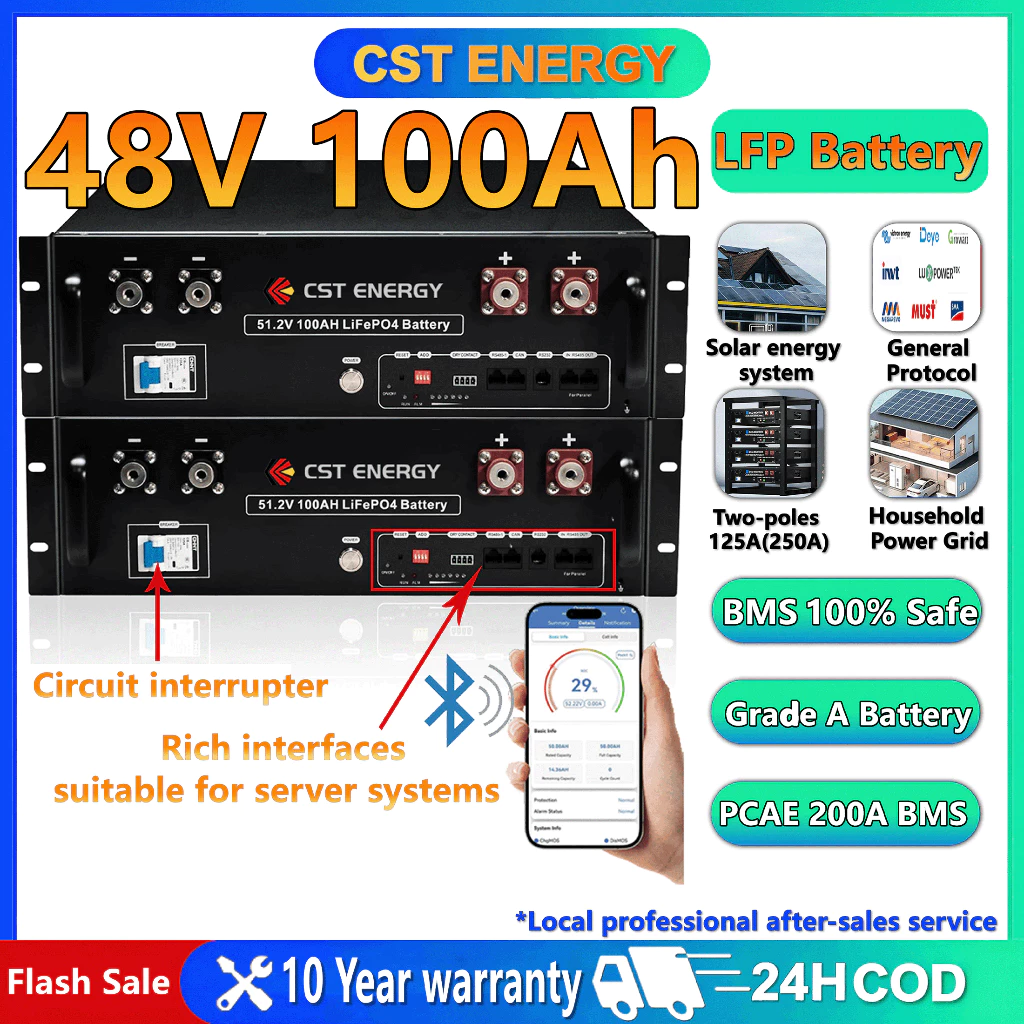
The featured Shopee listing offers CST Energy lithium iron phosphate or LiFePO₄ batteries, including 12-volt and 24-volt options with several available capacities. The listing specifically features 12V 100Ah and 12V 280Ah solar batteries with built-in battery management systems.
CHECK CURRENT SHOPEE PRICE
Why Consider LiFePO₄ for a Solar Panel Kit?
LiFePO₄ is a lithium battery chemistry commonly used for solar energy storage, backup power, recreational vehicles, boats, and other deep-cycle applications.
Compared with batteries intended mainly for starting engines, a solar battery must be capable of repeatedly storing and releasing energy. CST describes its LiFePO₄ range as suitable for solar, off-grid, recreational vehicle, and marine applications.
Built-in Battery Management System
One of the important features shown in the product listing is the built-in BMS or Battery Management System.
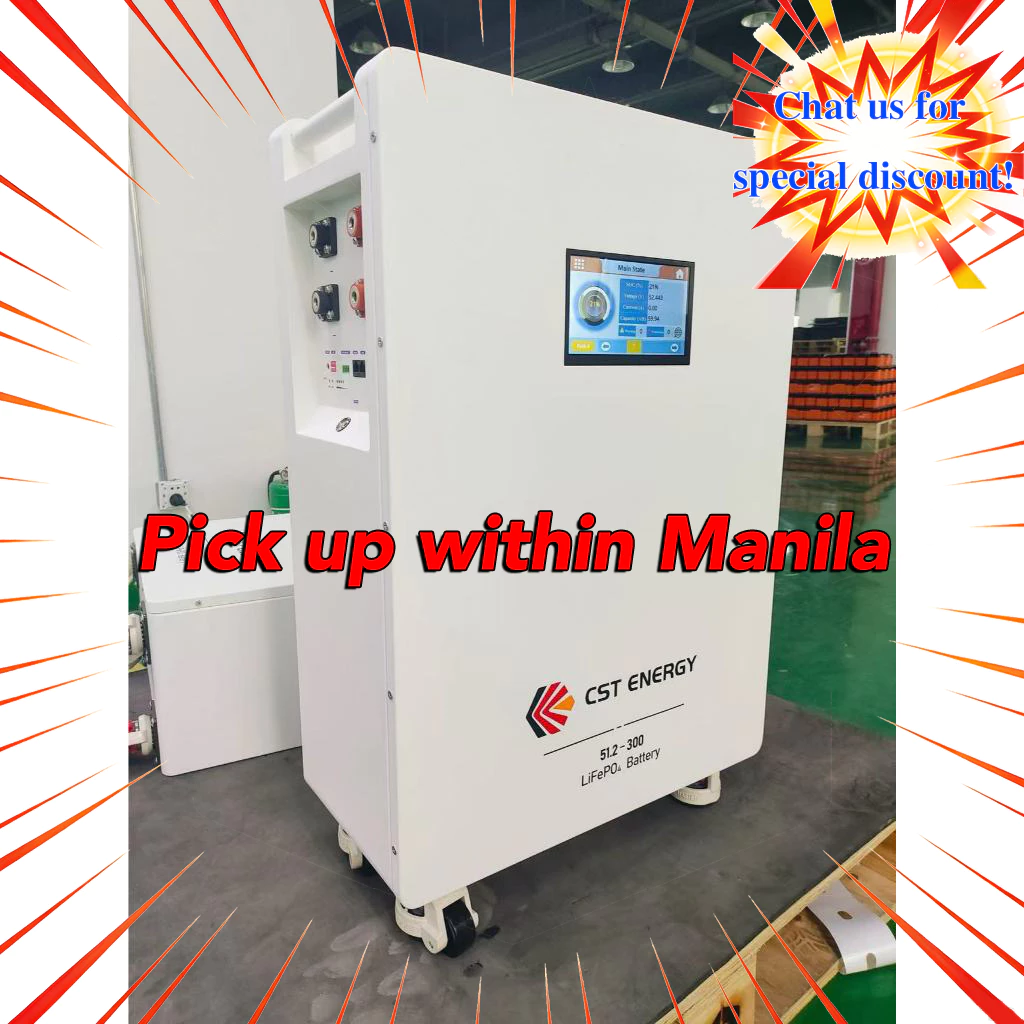
A BMS monitors and protects the battery during charging and discharging. CST states that the BMS in its 12.8V 100Ah model is designed to help protect against conditions such as:
- Overcharging
- Excessive discharge
- Short circuits
- Excessive current
- Other potentially damaging operating conditions
The BMS is an important part of a lithium battery system, but proper fuses, circuit breakers, wiring, connectors, ventilation, and equipment compatibility are still required.
Bluetooth Monitoring on Selected Models
Some of the battery variations shown in the seller’s product images include Bluetooth monitoring. CST’s official product information says its Bluetooth-enabled 100Ah model can display information such as voltage, current, temperature, and battery status through a mobile device.
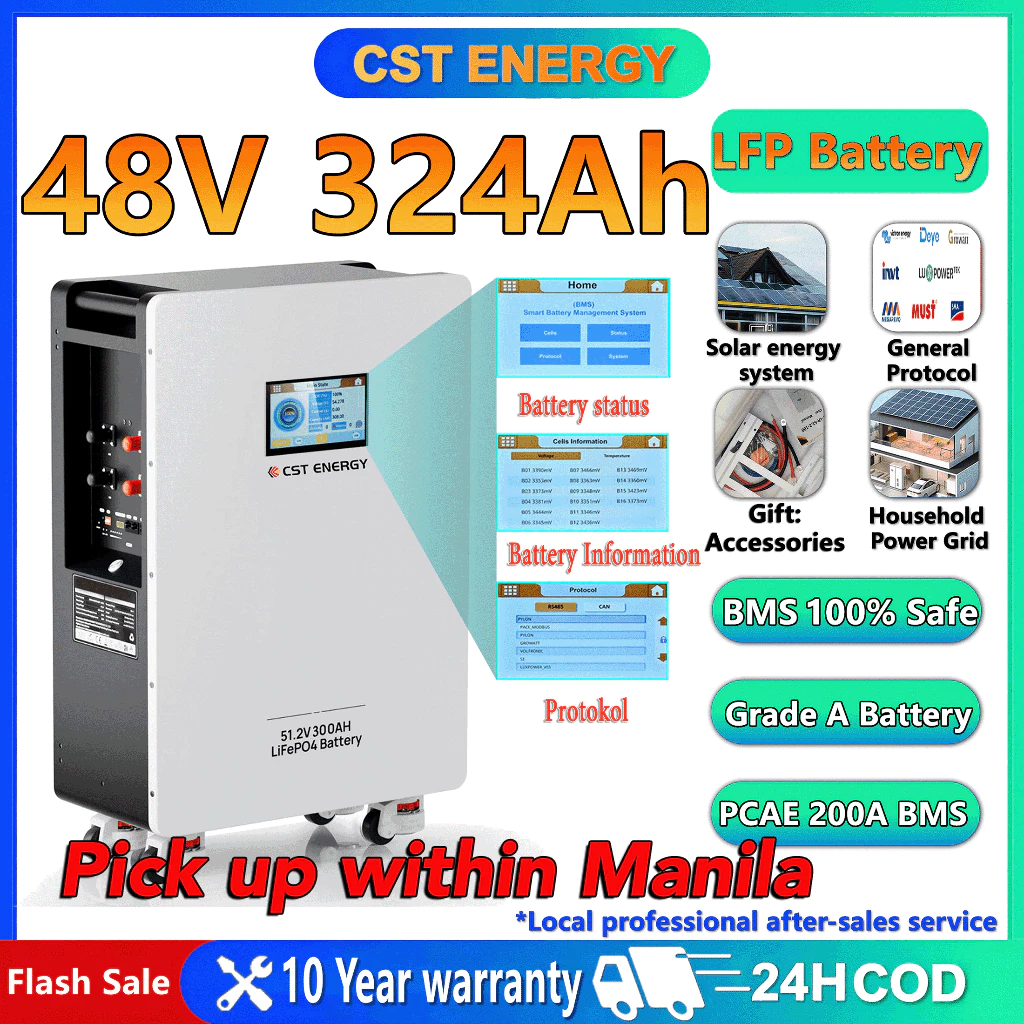
Bluetooth monitoring can be useful when the battery is installed inside:
- A solar equipment cabinet
- A vehicle
- A boat
- A remote communications enclosure
- A utility room
- A solar-powered farm facility
Check the selected Shopee variation carefully because not every size or version may include Bluetooth.
Available CST Energy Battery Sizes
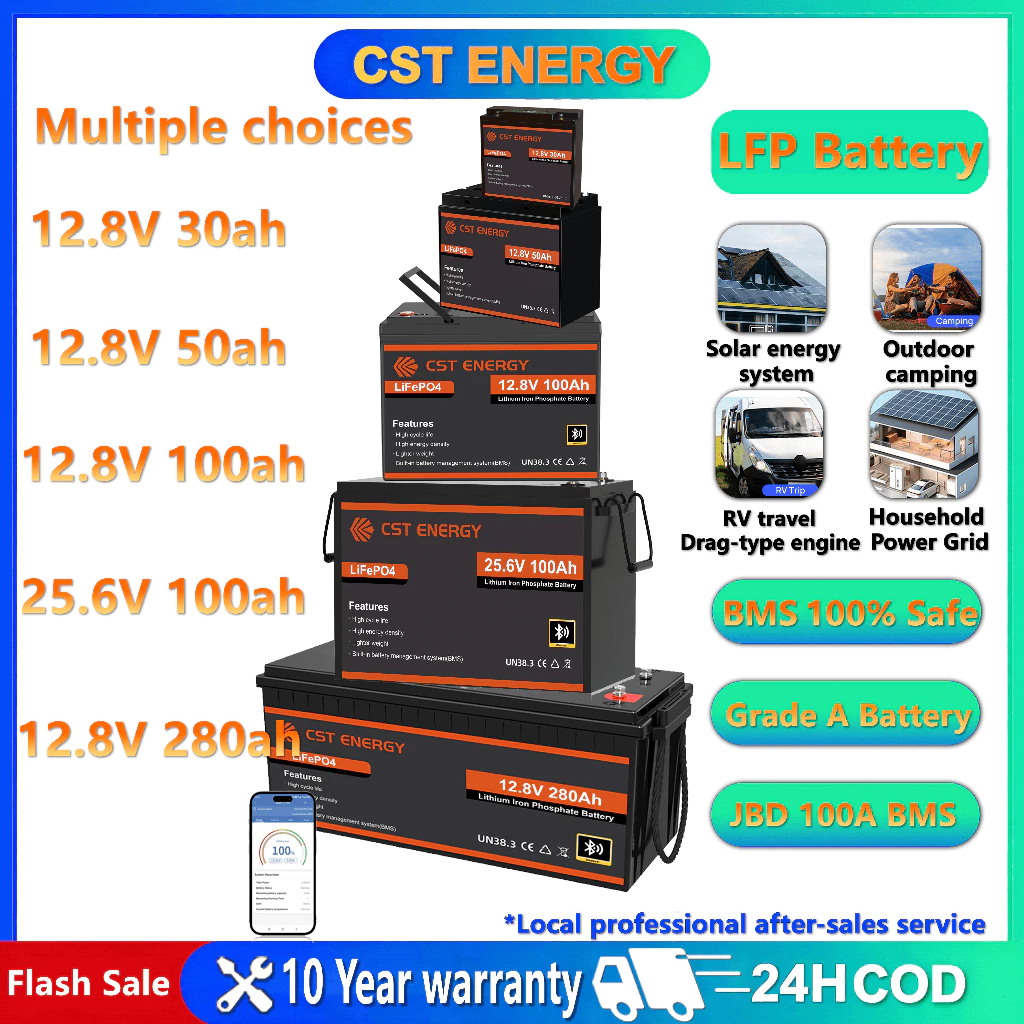
The Shopee listing shows multiple battery variations. Seller images include the following nominal sizes:
| Battery option | Approximate nominal energy | Possible application level |
|---|---|---|
| 12.8V 12Ah | 154Wh | Small lights, alarms and compact electronics |
| 12.8V 30Ah | 384Wh | Small CCTV, lighting or portable solar kits |
| 12.8V 50Ah | 640Wh | Medium lighting and communications systems |
| 12.8V 100Ah | 1,280Wh | Home backup, CCTV, internet and larger solar kits |
| 25.6V 100Ah | 2,560Wh | Compatible 24V solar and inverter systems |
| 12.8V 280Ah | 3,584Wh | Larger off-grid and backup-power installations |
Seller images also show standard and Bluetooth-equipped versions among the available choices.
Nominal energy is calculated using:
Battery voltage × ampere-hour capacity = watt-hours
Actual usable energy will be lower after accounting for operating limits, wiring losses, inverter efficiency, temperature, battery condition, and the BMS.
VIEW AVAILABLE BATTERY SIZES
Solar Applications for CST Energy Batteries
1. Home Emergency Solar Backup
Power interruptions can affect lighting, communication, internet access, work, and home security.
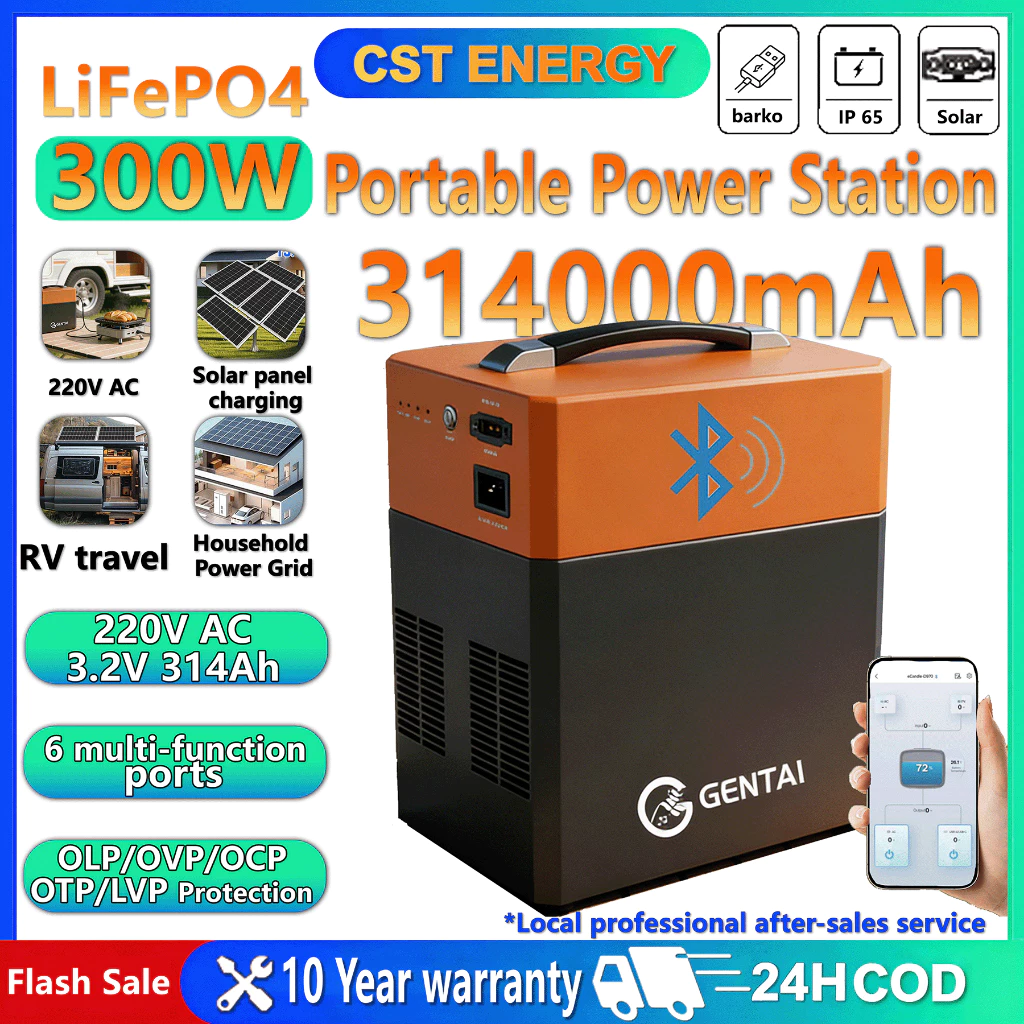
A properly designed solar kit with a CST Energy battery may provide backup power for selected essential loads such as:
- LED lights
- Wi-Fi routers
- Mobile phones
- Laptops
- Small fans
- Television sets
- CCTV cameras
- Device chargers
- Low-power communication equipment
The battery should not be selected based only on its ampere-hour rating. The installer must calculate the total wattage of the appliances, expected operating time, inverter losses, and starting surge of motors or compressors.
High-consumption appliances such as air conditioners, heaters, electric kettles, induction cookers, refrigerators, pumps, and power tools may require a much larger battery bank and inverter.
2. CCTV and Security Systems
A solar-powered CCTV system is useful in locations where grid electricity is unavailable or unreliable.
Possible installations include:
- Farms
- Warehouses
- Construction sites
- Vacant lots
- Remote gates
- Fishponds
- Poultry and livestock facilities
- Roadside properties
- Mountain or coastal locations
A complete solar CCTV system normally requires solar panels, a charge controller, a battery, protective devices, and suitable voltage converters or an inverter.
Smaller battery capacities may be enough for a few low-power cameras, while larger systems with multiple cameras, network switches, recorders, wireless radios, and nighttime infrared illumination require more storage.
3. Internet, Wi-Fi and Telecommunications Backup
Internet equipment normally uses less energy than many household appliances, making it a practical priority for battery backup.
A CST Energy battery can become part of a system supporting equipment such as:
- Fiber-optic modems
- Wi-Fi routers
- Outdoor access points
- Network switches
- Point-to-point wireless radios
- Mobile signal equipment
- Remote monitoring systems
- Selected satellite internet installations
For equipment such as Starlink, calculate the actual power consumption of the exact hardware version and include conversion losses. A suitable inverter or regulated DC power system may also be required.
This application can be valuable for schools, barangay facilities, disaster-response locations, farms, resorts, and communities where continuous communication is important.
4. Solar Lighting for Gardens, Pathways and Properties
Smaller CST battery options may be considered for custom solar-lighting projects such as:
- Garden lighting
- Pathway lighting
- Gate lights
- Perimeter lights
- Signboard lighting
- Shed lights
- Farm lighting
- Emergency outdoor lights
- Parking-area illumination
Battery capacity should be based on the total lamp wattage, number of nighttime operating hours, expected rainy days, and available solar-panel output.
For example, a system intended to operate throughout the night needs more battery storage than a motion-activated light that operates only occasionally.
5. Farms and Agricultural Facilities
Many agricultural facilities are located far from reliable electrical service. Solar battery systems can help provide basic power without extending long utility lines.
Potential farm applications include:
- Livestock-house lighting
- Poultry-house monitoring
- Electric fence energizers
- Water-level sensors
- Automatic feeders
- Security cameras
- Wi-Fi equipment
- Communication radios
- Small ventilation equipment
- Solar irrigation controls
- Remote weather stations
Water pumps and large motors require careful engineering because they may draw high starting currents. The battery, BMS, inverter, cables, fuses, and solar array must all be able to handle the pump’s operating and surge requirements.
6. Remote Water-Pumping Systems
Solar-powered water systems may be used for gardens, farms, livestock, remote homes, and water-storage tanks.
A battery can allow the pump to operate when sunlight is weak or when water is needed outside peak solar hours. However, battery storage is not always necessary for every solar-pumping installation. Some systems pump water directly during sunny periods and store the water in an elevated tank instead.
Where a battery is required, determine:
- Pump voltage
- Running wattage
- Starting surge
- Required pumping time
- Total head or lifting height
- Pipe size
- Solar-panel capacity
- Charge-controller rating
- Inverter rating, when applicable
Large pumps should be sized by a qualified solar installer or electrician.
7. Camping, Recreational Vehicles and Mobile Power
CST identifies its LiFePO₄ batteries as suitable for recreational vehicles and off-grid applications.
They may form part of a mobile power system for:
- Camping lights
- Portable refrigerators
- Fans
- Device charging
- Radios
- Laptops
- Small televisions
- Water pumps
- Mobile workstations
LiFePO₄ batteries should be securely mounted and protected from impact, moisture, excessive heat, and accidental short circuits while travelling.
8. Marine and Fishing Applications
CST also identifies marine use as one of the possible applications for its batteries.
Possible uses include powering:
- Navigation electronics
- Fish finders
- Communications equipment
- Cabin lighting
- Small pumps
- Radios
- Charging ports
- Auxiliary electronics
A battery installed on a boat should be placed in an appropriate enclosure and protected against water, salt exposure, movement, and terminal short circuits. Confirm whether the specific battery enclosure has the required environmental protection rating before using it in wet locations.
9. Small Businesses and Mobile Selling
A solar battery system may also support small businesses operating in places with unreliable electricity.
Possible applications include:
- Point-of-sale systems
- Internet routers
- Receipt printers
- LED lights
- Mobile charging stations
- Small kiosks
- Food carts
- Market stalls
- Mobile offices
- Remote cashier stations
Battery backup can help businesses continue accepting digital payments and communicating with customers during power interruptions.
10. Disaster Preparedness and Emergency Communication
Typhoons, flooding, earthquakes, and other emergencies can interrupt both electricity and communications.
A portable or permanently installed solar-battery system may support:
- Emergency lighting
- Mobile-phone charging
- Radios
- Internet equipment
- CCTV
- Small medical or monitoring devices, where approved
- Community coordination equipment
Critical medical equipment should not be connected to a general-purpose solar battery system unless the complete installation has been designed, tested, and approved for that purpose.
Understanding the 12.8V 100Ah Model
CST’s official specifications for one of its Bluetooth-equipped 12.8V 100Ah models include:
- Nominal voltage: 12.8V
- Rated capacity: 100Ah
- Nominal energy: 1,280Wh
- Maximum continuous charging current: 100A
- Maximum continuous discharge current: 100A
- Recommended charging current: 50A
- Recommended charging voltage: 13.8V to 14.6V
- Bluetooth monitoring
- Built-in BMS
The official specifications are useful for understanding the product category, but buyers should confirm that the exact Shopee variation has the same specifications before ordering.
What Does 1,280Wh Mean?
A 12.8V 100Ah battery has a nominal stored-energy rating of approximately:
12.8 volts × 100 ampere-hours = 1,280 watt-hours
This does not mean it can always deliver the entire 1,280Wh to AC appliances. Real-world output depends on:
- Permitted depth of discharge
- BMS settings
- Inverter efficiency
- Cable losses
- Battery temperature
- Appliance surge requirements
- Battery age
- Charging and discharging rate
As a basic planning formula:
Estimated operating time = usable battery watt-hours ÷ appliance wattage
Always include a reasonable safety allowance rather than designing a system that depends on the battery’s full theoretical capacity.
Choosing Between 12V and 24V
A 12V battery is commonly used in small solar kits, vehicles, boats, CCTV systems, and basic backup installations.
A 24V system can be more practical for higher-power loads because it can deliver the same wattage at a lower current than a 12V system. Lower current can reduce cable-size requirements and electrical losses, although the complete system must be designed for 24V.
Never connect a 24V battery to equipment designed only for 12V.
The following must all be compatible with the selected system voltage:
- Solar charge controller
- Inverter
- DC appliances
- Battery monitor
- Protective devices
- Wiring
- Chargers
- Additional batteries
Important Installation Requirements
A LiFePO₄ battery is not a complete solar kit by itself. A properly designed system may also require:
- Solar panels
- An MPPT or PWM charge controller compatible with LiFePO₄
- An inverter when supplying standard AC appliances
- Correctly sized battery cables
- DC fuses or circuit breakers
- Battery isolation switch
- Proper terminals and connectors
- Secure battery enclosure or mounting
- Grounding and surge protection where required
- Professional installation for larger systems
CST recommends a charging voltage of 13.8V to 14.6V for its official 12.8V 100Ah Bluetooth model. This is one reason the charge controller or charger must have settings suitable for LiFePO₄ batteries.
Do not assume that every charger designed for lead-acid batteries is automatically suitable for lithium batteries.
Check the Warranty and Seller Claims
The Shopee seller’s promotional images advertise features such as a built-in JBD BMS, Bluetooth on selected models, a five-year warranty, and a claimed cycle life of more than 15,000 cycles. These are seller or manufacturer advertising claims and may depend on the exact variation, operating conditions, depth of discharge, temperature, and warranty terms.
Before purchasing, ask the seller to confirm:
- Exact model number
- Actual capacity
- BMS current rating
- Bluetooth availability
- Maximum series and parallel configuration
- Warranty coverage
- Warranty registration process
- Return procedure
- Recommended charge voltage
- Recommended maximum inverter size
- Battery dimensions and weight
- Local service or replacement procedure
Keep screenshots of the listing, order details, warranty statements, and seller conversation.
Who Is This Battery Best For?
CST Energy LiFePO₄ batteries may be worth considering for buyers who are building or upgrading:
- Home solar kits
- Off-grid cabins
- Farm power systems
- Solar CCTV installations
- Outdoor lighting
- Internet backup systems
- Mobile power stations
- Recreational vehicles
- Marine auxiliary systems
- Small-business backup power
- Emergency communication kits
The wide choice of capacities makes it possible to select a smaller battery for basic electronics or a higher-capacity model for more demanding solar installations.
Final Thoughts
A well-designed solar system can provide dependable energy for homes, farms, businesses, security systems, communications equipment, and remote facilities.
The battery is where solar energy is stored, so its capacity, voltage, BMS rating, charging requirements, and compatibility with the rest of the system must be carefully considered.
CST Energy offers several LiFePO₄ sizes through its Shopee listing, from compact 12.8V batteries to larger 100Ah and 280Ah options. Selected models also advertise Bluetooth monitoring and built-in battery-management protection.
[EXPLORE CST ENERGY LiFePO₄ BATTERIES ON SHOPEE — INSERT YOUR AFFILIATE LINK HERE]
Buying reminder: Select the correct battery variation before checkout. Prices, vouchers, delivery terms, product specifications, and promotions may change. Confirm your solar-panel, controller, inverter, wiring, and appliance requirements with a qualified installer before purchasing.
Affiliate disclosure: This article contains affiliate links. I may receive a small commission when you purchase through these links, at no additional cost to you.